Archaeology
Where was Jesus crucified? Golgotha, the Holy Sepulchre, and the Garden Tomb
- Era
- 1st century AD
- Location
- Jerusalem
The archaeological and historical case for the location of Jesus' crucifixion and burial — weighing the Church of the Holy Sepulchre, the Garden Tomb, and the Gospel evidence for Golgotha just outside Jerusalem's walls.
The find
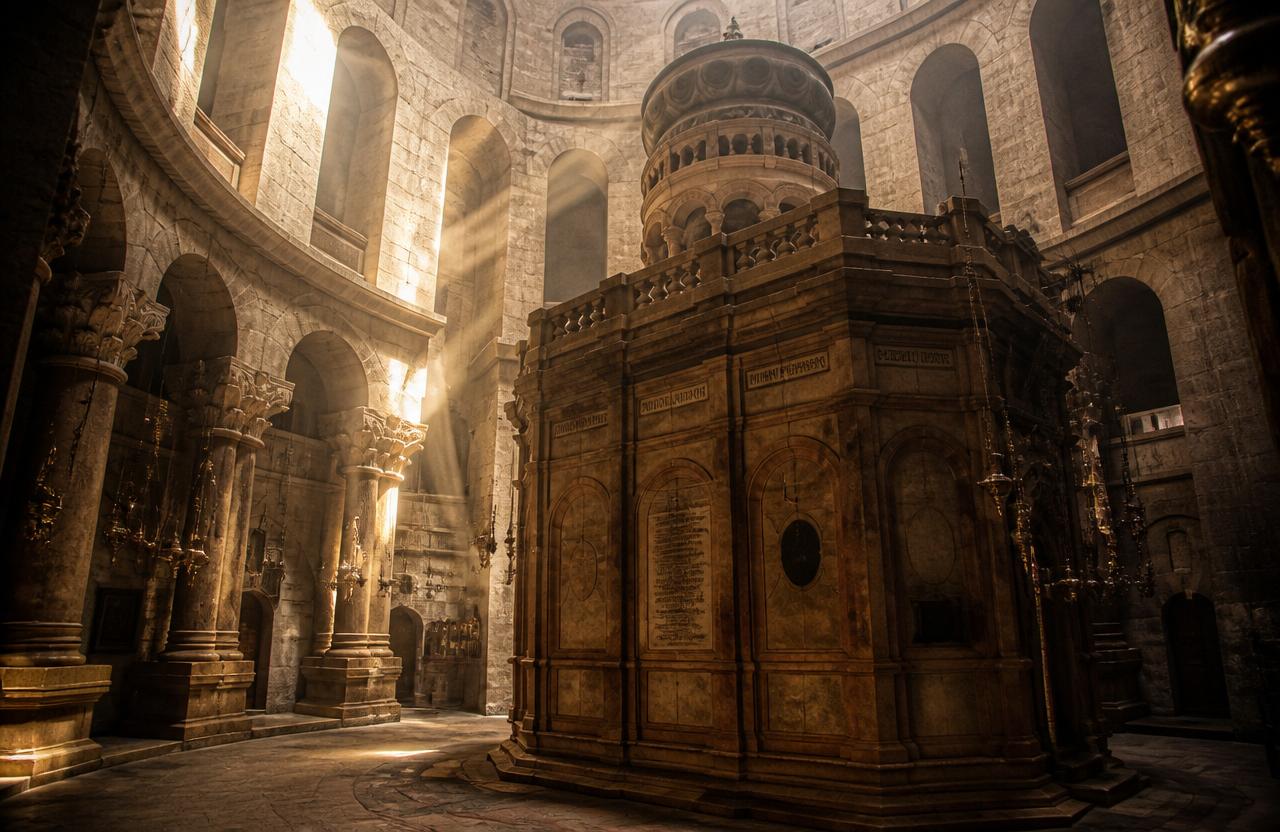
### Why the location matters All four Gospels insist Jesus was crucified at a real, identifiable place — *Golgotha*, "the place of a skull" (Matthew 27:33; Mark 15:22; Luke 23:33; John 19:17) — and buried in a nearby rock-cut tomb owned by Joseph of Arimathea (John 19:41–42). Hebrews 13:12 adds a critical geographic detail: Jesus "suffered outside the gate." Any candidate site must sit **outside the city wall of AD 30** yet **near enough to a public road** for passersby to read the titulus (Mark 15:29). ### Candidate 1 — The Church of the Holy Sepulchre This is the site venerated continuously since the second century and is the leading candidate of mainstream archaeology. - **Continuous local memory.** Eusebius (*Life of Constantine* 3.25–28) records that when Constantine cleared a pagan temple of Aphrodite from the site in c. AD 326, the rock of Calvary and an empty rock-cut tomb were uncovered beneath it. Hadrian had built that temple over the site around AD 135 — a hostile act that ironically **preserved its location** in living memory. - **Outside the wall of AD 30.** Excavations by Virgilio Corbo (1960s) and Magen Broshi (1970s) confirmed the site lay outside the "Second Wall" of Jerusalem in Jesus's day; Herod Agrippa's "Third Wall" only enclosed it around AD 41–44 (Josephus, *War* 5.146). - **A working quarry and tomb field.** Beneath the church, archaeologists have identified a disused limestone quarry with first-century *kokhim* (shaft) and *arcosolia* (bench) tombs cut into its walls — exactly the burial type John 19:41 describes. - **Skull-shaped outcrop.** A vertical rock spur rising about 4–5 m from the quarry floor matches the name "Place of a Skull." ### Candidate 2 — The Garden Tomb Proposed by British general Charles Gordon in 1883, this site north of the Damascus Gate became popular with Protestants who could not access the Holy Sepulchre freely under Ottoman rule. - **Pros.** A skull-shaped cliff face is visible from the road; a quiet garden with a rock-cut tomb feels evocative; it is undeniably outside the modern walls. - **Cons.** The tomb itself has been dated by the Garden Tomb Association's own scholars (notably Gabriel Barkay) to the **Iron Age (8th–7th c. BC)**, centuries before Jesus. John 19:41 specifies "a new tomb in which no one had yet been laid," which an Iron-Age tomb is not. Most archaeologists today, including evangelical scholars such as Jodi Magness and Craig Evans, regard the Garden Tomb as **devotionally meaningful but historically improbable**. ### What the Gospels require | Detail | Source | Test | |---|---|---| | Outside the city gate | Heb 13:12; John 19:20 | Holy Sepulchre ✓ (AD 30); Garden Tomb ✓ | | Near a road | Matt 27:39; Mark 15:29 | Both ✓ | | Near a garden | John 19:41 | Holy Sepulchre ✓ (quarry with garden plots attested); Garden Tomb ✓ | | New, unused, rock-cut tomb | Matt 27:60; John 19:41 | Holy Sepulchre ✓ (first-century type); Garden Tomb ✗ (Iron Age) | | Belonged to a wealthy man | Matt 27:57–60 | Holy Sepulchre ✓ (arcosolium tomb = elite) | | Sealable with a rolling/blocking stone | Mark 15:46 | Both possible | ### Recent scientific dating In 2016 the National Technical University of Athens led the first restoration of the Edicule (the small shrine over the tomb) in 200 years. When the marble cladding was removed, the **original limestone burial bench was exposed for the first time since 1555**. Mortar samples sealed between the bench and a marble slab placed over it returned a date of **c. AD 345**, consistent with Constantine's 4th-century enclosure — meaning the structure protecting this rock surface has been continuous for ~1,700 years (*National Geographic*, Oct 2016; published in *Journal of Archaeological Science: Reports*, 2017). ### Bottom line The archaeology, the topography, the burial-type, and the unbroken chain of veneration all converge on the **Church of the Holy Sepulchre** as the most defensible historical location of Golgotha and Jesus's tomb. The Garden Tomb is a beautiful place to reflect on the resurrection but does not meet the historical criteria the Gospels themselves require. "He is not here, for he has risen, as he said. Come, see the place where he lay." — Matthew 28:6
Why it matters
The crucifixion and burial of Jesus are anchored in a real, datable, excavatable place. The convergence of literary, topographical, and archaeological evidence at the Church of the Holy Sepulchre quietly answers the common skeptical claim that the Gospel accounts are vague legend rather than historical testimony.
Cross-linked Scripture
- John 19:17–20— Crucified at "the Place of the Skull" — outside the city.
- John 19:41— A garden near the place of crucifixion, with a new tomb.
- Matthew 27:60— Joseph of Arimathea's own new rock-cut tomb.
- Luke 23:53— "A tomb in which no one had ever yet been laid."
- Hebrews 13:12— Jesus suffered "outside the gate."
Doctrine check
Sources
- ·Eusebius, Life of Constantine 3.25–28
- ·Magness, Jodi. The Archaeology of the Holy Land (Cambridge, 2012), ch. 8
- ·Biblical Archaeology Society — Where Is Golgotha?
- ·Moropoulou et al., Five-Year Research of the Holy Sepulchre, Journal of Archaeological Science: Reports (2017)
- ·National Geographic — Exclusive: Christ's Burial Place Exposed for First Time in Centuries (2016)
Image: Illustration: rotunda and aedicule of the Church of the Holy Sepulchre, Jerusalem.
Discuss with AI