Archaeology
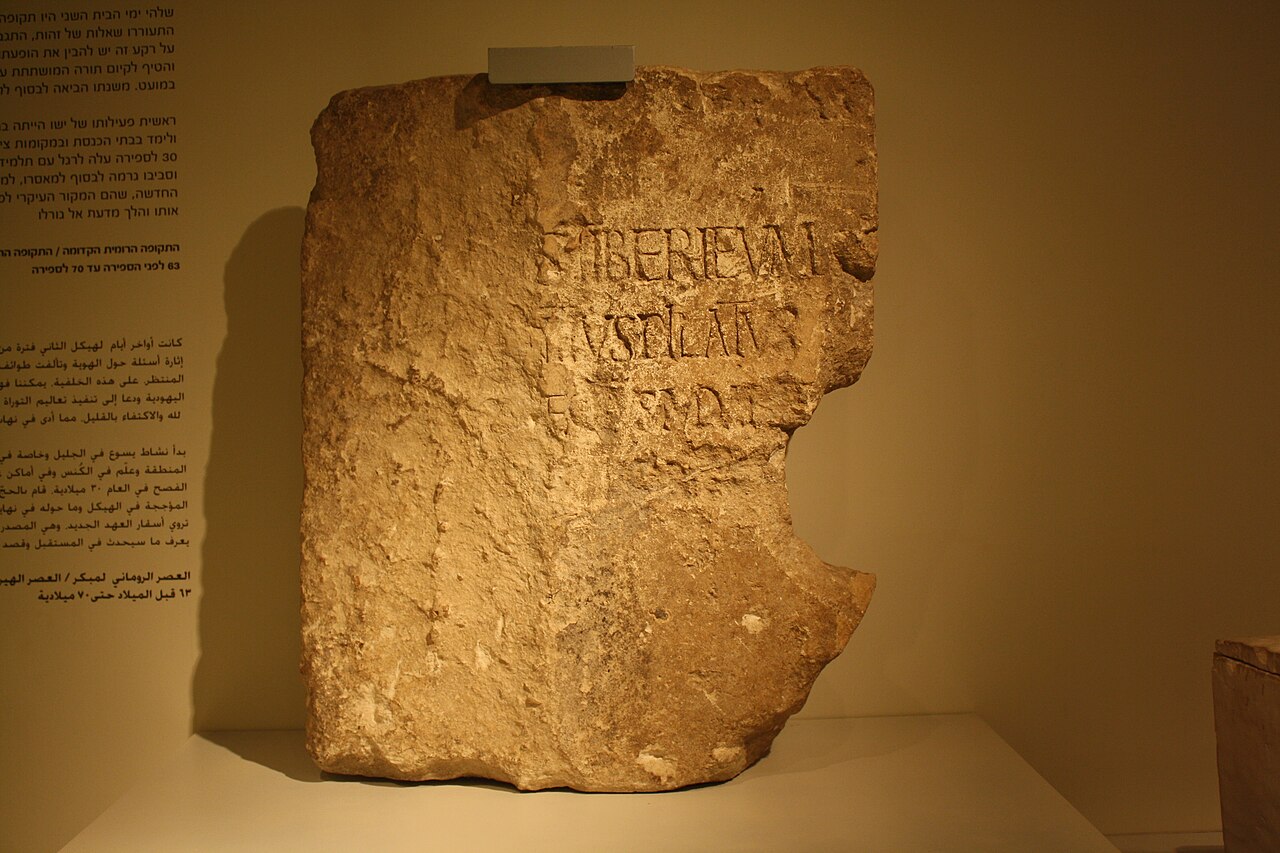
The Pilate Stone
- Era
- 1st century AD
- Location
- Caesarea Maritima, Israel
- Discovered
- 1961
A limestone block bearing a Latin inscription that names "Pontius Pilatus, Prefect of Judea" — direct epigraphic confirmation of the very Roman governor who tried Jesus.
The find
Discovered in 1961 by Italian archaeologist Antonio Frova during excavations of the Roman theater at Caesarea Maritima, the stone had been reused as a step. The partial inscription reads "[…]S TIBERIEVM / [PON]TIVS PILATVS / [PRAEF]ECTVS IVDA[EA]E" — Pontius Pilatus, Prefect of Judaea. Before this find, Pilate was attested only in literary sources (the Gospels, Josephus, Tacitus, Philo).
Why it matters
It confirms the historicity, the name, and even the exact title of the Roman official who condemned Jesus. The title "Prefect" (not the later "Procurator") matches the correct early-first-century usage and lines up with the Gospel accounts.
Cross-linked Scripture
Doctrine check
Sources
- ·Israel Museum catalog: Pilate Inscription
- ·Frova, A. (1961). L'iscrizione di Ponzio Pilato a Cesarea. Rendiconti dell'Istituto Lombardo, 95: 419-434
See also

Image: Israel Museum, Jerusalem · Photo: Wikimedia Commons (public domain)
Discuss with AI