History
The Dead Sea Scrolls at Qumran
- Era
- c. 250 BC – AD 68
- Location
- Qumran, north-western shore of the Dead Sea, Judaea
- Discovered
- Caves 1–11 discovered between 1947 and 1956
A library of roughly 900 manuscripts hidden in eleven caves above the Dead Sea — Old Testament scrolls a thousand years older than any copy previously known, sitting alongside Jewish writings that never became Scripture.
The find
A Bedouin shepherd looking for a stray goat threw a stone into a cave near Qumran in 1947 and heard pottery break. What came out of that cave, and the ten others found over the next nine years, changed the study of the Bible more than any other discovery of the twentieth century. **What the library actually contains.** Roughly 900 manuscripts survive, most of them in thousands of fragments. About a quarter are copies of Old Testament books — every book of the Hebrew Bible is represented except Esther. Another portion consists of commentaries (pesharim), paraphrases and expansions of biblical stories. The rest are the writings of the community that kept the library: rules for communal life, hymns, calendars, and a battle plan for the end of the age. **The point most often missed.** The scrolls are not a rival Bible with extra books that were later "removed." They are a library. Finding a writing at Qumran tells you that somebody there read it and copied it. It does not tell you that they regarded it as Scripture. The community copied Isaiah and they copied their own house rulebook; nobody thinks those two stood on the same footing. Some of the non-biblical writings — Jubilees and 1 Enoch above all — do appear to have been treated as authoritative by this group. Others plainly were not. **Which books were found there.** Biblical manuscripts include Genesis, Exodus, Leviticus, Numbers, Deuteronomy, Isaiah, Jeremiah, Ezekiel, Daniel, Psalms, Proverbs, Job, Ruth, Song of Songs, Ecclesiastes, Lamentations, Ezra–Nehemiah and Chronicles. The Great Isaiah Scroll is virtually the whole book in a single scroll copied around 125 BC. **What was not found there.** No copy of 1 or 2 Maccabees has been identified among the scrolls, and no copy of Esther. Baruch and the Prayer of Manasseh are likewise absent. The Maccabean books describe the same century in which the Qumran settlement began, but they belong to a different stream of Jewish life — one that celebrated the priestly dynasty this community had rejected. **Who wrote them.** The traditional identification is the Essenes, a strict separatist movement described by Josephus, Philo and Pliny the Elder. That remains the majority view, though a minority of scholars argue the scrolls were a wider Jerusalem collection hidden in the caves before the Roman advance of AD 68.
Why it matters
For the reliability of the Old Testament, the scrolls are decisive. Before 1947 the oldest complete Hebrew Bible was the Aleppo Codex of about AD 930. The Qumran copies are a thousand years older, and where they can be compared with the medieval text the agreement is overwhelming — differences are largely matters of spelling and word order, not content. A thousand years of hand copying did not corrupt the text. For reading the New Testament, the scrolls are the best window we have into the Jewish world Jesus and the apostles lived in. Ideas that once looked distinctively Christian — a coming Messiah, a final judgment, a conflict between light and darkness, an eschatological community of the righteous — are shown to have been in circulation in Judaea before Christianity existed. That does not make the New Testament derivative; it makes it intelligible. Jesus spoke to people who already had these categories. The scrolls also settle a popular claim in the negative. There is no Qumran manuscript of any Gospel, no lost teaching of Jesus, and no evidence that books were cut out of the Bible by a later council. That story belongs to fiction, not to the caves.
Cross-linked Scripture
- Isaiah 40:3— The verse the Qumran community used to justify its retreat to the desert
- Isaiah 53:1-12— Preserved intact in the Great Isaiah Scroll, copied c. 125 BC
- Daniel 7:9-14— Daniel was copied at Qumran; eight manuscripts survive
Doctrine check
Sources
- ·Emanuel Tov, 'Textual Criticism of the Hebrew Bible' (Fortress Press, 3rd ed. 2012)
- ·Geza Vermes, 'The Complete Dead Sea Scrolls in English' (Penguin, 2011)
- ·John J. Collins, 'The Dead Sea Scrolls: A Biography' (Princeton, 2013)
- ·Lawrence H. Schiffman, 'Reclaiming the Dead Sea Scrolls' (JPS, 1994)
- ·The Leon Levy Dead Sea Scrolls Digital Library (Israel Antiquities Authority)
See also
Manuscripts
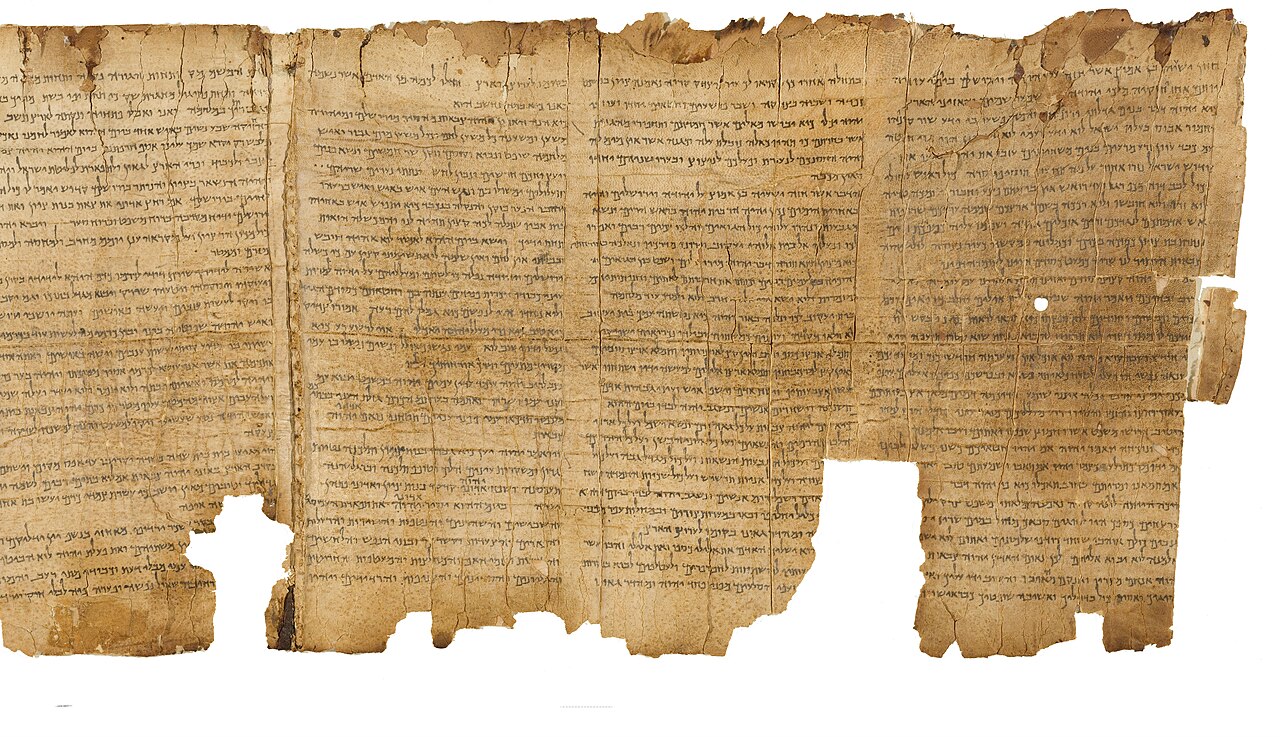
Great Isaiah Scroll (1QIsaᵃ)
The oldest complete Isaiah, from Cave 1
Manuscripts
The Book of Enoch Manuscripts
Aramaic Enoch fragments from Cave 4
Manuscripts
The Book of Jubilees
Fifteen copies — more than most biblical books
Manuscripts
The Community Rule (1QS)
The community's own constitution
Manuscripts
The War Scroll (1QM)
Its plan for the final war
Manuscripts
The Genesis Apocryphon (1QapGen)
Genesis retold in Aramaic
Manuscripts
The Temple Scroll, 4QMMT and the Thanksgiving Hymns
The temple they wanted and the letter they sent